Recent Gallery


Tampilkan postingan dengan label Worlds Fastest. Tampilkan semua postingan

The Fastest Train - CRH3


The world fastest recently introduced by China has a maximum speed of 245 mph (394 km/h)
with an average speed of 217 mph (350 km/h). The train is developed by
Siemens, Bombardier and Alstom. According to China Railway minister it
is currently the fastest train on the surface of earth.

 China is preparing special speed tracks for this train which will be
completed in 2012. 42 different projects of spreading speed lines are
currently in progress for the train. After the completion of these new
tracks, c The new speed tracks of railways lines will increased from
53,437 miles to 74,564 miles.


Source: www.pickchur.com, 4rail.net

10 Fastest Land Animals in the World

10 Fastest Land Animals in the World

If wild animals could participate in the Olympics, the land animals of the wild would outrun any human. Most animals use their speed when overpowering prey or escaping a predator. The following maximum speed measurements "are based on measurements recorded over approximately quarter-mile distances. Exceptions are the lion, which was clocked in the act of charging, and the cheetah, which was measured over a 100-yard distance," notes the TravelAlmanac.com.


1. Cheetah

The world's fasted land animal is the cheetah. The cheetah has an "acceleration that would leave most automobiles in the dust; a cheetah can go from 0 to 60 mph in only 3 seconds," according to the National Geographic. This large cat has exceptional eyesight to scan for prey. The sleek and flexible spotted body of a cheetah provides camouflage for dry grasslands in Southern and East Africa, where about 12,000 endangered wild cheetahs exist.


2. Pronghorn Antelope

For more than a million years, the pronghorn antelope has roamed North America. "The running gait of the pronghorn is beautifully smooth and their powerful legs can carry them at a remarkable pace across the roughest kind of terrain. Pronghorns can reach speeds of 60 mph," notes the National Park Service.


3. Lion

Lions roam grassy plains and open woodlands of the sub-Saharan region. Lions may be as long as 48 inches and weigh up to 500 pounds. When looking for prey the lion can reach speeds as fast as 50 mph.


4. Thomson's Gazelle

The Thomson's gazelle roams the grasslands and open plains of northern Tanzania and southern Kenya. This gazelle weighs 35 to 55 pounds and is exceptionally alert to sounds and movements, and its fine sense of hearing, sight and smell balances its vulnerability on the open plains, according to the Out to Africa website. The Thomson's gazelle is able to run 50 mph.


5. Wildebeest

The wildebeest belongs to the antelope family. The Afrikaans began calling the gnu the wildebeest because it had a shaggy mane, sharp horns, pointed beard and a huge head. Wildebeest can weigh as much as 600 pounds and run as fast as 50 mph. The wildebeest roams the woodlands and plains of sub-Saharan Africa.


6. Springbok

A springbok may reach a speed of 50 mph. The springbok's main predators consist of leopards, lions, humans and lions. This reddish-brown, small antelope may leap up to 13 feet. This South African animal lives in semiarid and grassland regions.


7. Quarter Horse

The quarter horse has heavy muscling, a stocky built and a compact appearance. This well-defined horse can sprint 47.5 mph. "Quarter horses are quick, balanced and agile. They are collected in action and stand at ease with their legs well under them. They are even-headed, kind, surefooted and steady," notes the Ultimate Horse Site.


8. Cape Hunting Dog

Identified by a distinctive coat of black, red, white and yellow, the Cape hunting dog reaches speeds of 45 mph. The Cape hunting dog travels in pack of six to 20 animals. A pack of these dogs may pursue large prey, such as antelope and wildebeest, especially if injured or sick.


9. Elk

In North America, the elk is the largest deer. The wapiti is another name for the elk, which means "light-colored deer." The elk can go as fast as 45 mph when it needs to avoid danger. The elk is a massive animal; therefore most animals do not bother the elk. An elk's antlers may grow up to 4 feet, making the tip of the animal's horns as high as 9 feet off the ground.


10. Coyote

The coyote runs up to 40 mph. Coyotes are able to adapt to North America's changing landscape. These clever animals eat rodents, fish, frogs, deer and snakes. With their keen sense of smell and strong vision, this member of the dog family typically forms a pack with other coyotes to hunt prey together in the fall and winter months.

Very Fast Legs

Online Driving Simulator by Ferrary Virtual Academy


Ferrari will opens an Online Driving Simulator for all their fans on 9th September. With Ferrari Virtual Academy
now all ferrari big fans will experience drive their F10 single-seater
on this online driving simulator. Well this Online Driving Simulator by
ferrari could be a new breakthrough in racing games in the future.


Ferrari
fans have every reason to celebrate as the brand is to release a new
technologically advanced simulator. The racing enthusiasts and Ferrari
fans can drive their F10 single-seater simulator against each other
online. The simulator will run at the circuits of Fiorano, Mugello and
the Nürburgring. The racing game, Ferrari Virtual Academy 2010, has been
developed with the help of the Scuderia Ferrari engineers and is to
benefit from Ferrari’s own experience and specialty at F1. And, in order
to provide the realistic driving dynamics, each of the tracks was
digitally created with Laser Scan and Motion Capture. The game will be
available to download from September, 2010 and one has to shell out $20
for that. Hit the jump to checkout the game’s official trailer after the
jump.


Via : Automotto

The Fastest Animal on the Planet - Peregrine Falcon

The Peregrine Falcon (Falco peregrinus), also known simply as the Peregrine, and historically as the "Duck Hawk"
in North America, is a cosmopolitan bird of prey in the family
Falconidae. It is a large, crow-sized falcon, with a blue-gray back,
barred white underparts, and a black head and "moustache". It can reach
speeds over 320 km/h (200 mph) in a stoop, making it the fastest
animal on the planet. As is common with bird-eating raptors, the female
is much bigger than the male. Experts recognize 17–19 subspecies, which
vary in appearance and range; there is disagreement over whether the
distinctive Barbary Falcon is a subspecies or a distinct species.


The Peregrine's breeding range includes land regions from the Arctic
tundra to the Tropics. It can be found nearly everywhere on Earth,
except extreme polar regions, very high mountains, and most tropical
rainforests; the only major ice-free landmass from which it is entirely
absent is New Zealand. This makes it the world's most widespread bird of
prey. Both the English and scientific names of this species mean
"wandering falcon", referring to the migratory habits of many northern
populations.


While its diet consists almost exclusively of medium-sized birds, the
Peregrine will occasionally hunt small mammals, small reptiles or even
insects. It reaches sexual maturity at one year, and mates for life. It
nests in a scrape, normally on cliff edges or, in recent times, on tall
human-made structures. The Peregrine Falcon became an endangered species
in many areas due to the use of pesticides, especially DDT. Since the
ban on DDT from the beginning of the 1970s onwards, the populations
recovered, supported by large scale protection of nesting places and
releases to the wild.


Source

World's Fastest Cars - Top 10 List 2009-2010

While most of us can only dream of owning the fastest car in the world, some will do whatever it takes to possess such speed and power.So, how fast are the fastest cars in the world? Here is the 10 fastest cars available on the market measures by top speed.


1. SSC Ultimate Aero

257 mph, 0-60 in 2.7 secs. Twin-Turbo V8 Engine with 1183 hp, base price is $654,400. Tested in March 2007 by Guinness world records, The SSC Ultimate Aero takes the lead as the fastest car in the world beating Bugatti Veyron.


2. Bugatti Veyron

253 mph, 0-60 in 2.5 secs. Aluminum, Narrow Angle W16 Engine with 1001 hp, base price is $1,700,000. With the highest price tag, no wonder this is rank #2.


3. Saleen S7 Twin-Turbo

248 mph, 0-60 in 3.2 secs. Twin Turbo All Aluminum V8 Engine with 750 hp, base price is $555,000. Smooth and bad-ass, will make you want to show it off non-stop.


4. Koenigsegg CCX

245 mph, 0-60 in 3.2 secs. 90 Degree V8 Engine 806 hp, base price is $545,568. Made in Sweden, it is aiming hard to be the fastest car in the world, but it has a long way to go to surpass the Bugatti and the Ultimate Aero.


5. McLaren F1

240 mph, 0-60 in 3.2 secs. BMW S70/2 60 Degree V12 Engine with 627 hp, base price is $970,000. Check out the doors, they looks like bat wings, maybe Batman need to order one and paints it black


6. Ferrari Enzo

217 mph, 0-60 in 3.4 secs. F140 Aluminum V12 Engine with 660 hp, base price is $670,000. Only 399 ever produced, the price goes up every time someone crashes.


7. Jaguar XJ220

217 mph, 0-60 in 3.8 secs. Twin Turbo V6 Engine with 542 hp, base price was $650,000. Made in 1992, this car still got what it takes to make the list.


8. Pagani Zonda F

215 mph, 0-60 in 3.5 secs. Mercedes Benz M180 V12 Engine with 650 hp, base price is $667,321. With a V12 motor, this baby can do much better.


9. Lamborghini Murcielago LP640

211 mph, 0-60 in 3.3 secs. V12 Engine with 640 hp, base price is $430,000. Nice piece of art, the design is very round and smooth.


10. Porsche Carrera GT

205 mph, 0-60 in 3.9 secs. Aluminum, 68 Degree, Water Cooled V10 Engine with 612 hp, base price is $440,000. The most powerful and most expensive Porsche nearly made the list as #10.

Source

World's Fastest Muscle (In the tongue of a salamander)


World's Fastest Muscle (In the tongue of a salamander) 01
We all know chameleons, especially for some of their performances, like
the ability of changing color or for their special hunting technique. 


While the ability of changing color is not so singular
in the animal world (many fishes, cephalopods like octopuses and squids,
or even other lizards have it), their technique of projecting an
enormously long sticky tongue is regarded by many as very specific. 


That's wrong, as exactly the same method of catching prey is employed by a group of salamanders from the Americas.


Moreover,
a new research at University of South Florida found an unusual record
for these animals: the giant palm salamander of Central America shoots
out its tongue with the fastest speed developed by any known muscle in
the animal world.


The species, Bolitoglossa dofleini,
can shoot out its tongue at 18,000 watts of power per muscular kilogram,
about twice more than the power output broken out by the previous
record detainer, the Colorado River toad Bufo alvarius.


Bolitoglossa
extends its tongue (which measures more than half of its body length)
in about 7 milliseconds, 50 times faster than an eye blink. The research
team employed high-speed video cameras and electrodes implanted in the
salamanders' tongue muscles to check the animals' performances as they
hunted live crickets.


World's Fastest Muscle (In the tongue of a salamander) 03
The fact that the tongues were propelled outward much faster than by
sheer muscle contraction made the researchers suppose there must be an
unknown elastic tissue connected to the salamander's tongue that stores
up the energy amounts required by the explosive projection. 


The
process can be compared to the stretching and shooting of a rubber
band: the recoil occurs faster than the act of releasing a rubber band
pulled taut. "The amount of energy doesn't change; it's just released
faster," said lead researcher Stephen Deban. 


Tongue-launching
systems found in other species is formed by three components: a motor
to produce energy, a spring to store it and a latch to control the
unloading of the spring, but by now only the motor in the salamander
system has been found. "What remains to be discovered are the anatomical
structures that make up the spring and the latch" said Deban.


World's Fastest Muscle (In the tongue of a salamander) 02


World's Fastest Muscle (In the tongue of a salamander) 04

World's Fastest Plants

Bunchberry - World's fastest plant explodes with pollen


0505_canadian_dogwood_02 Cornus
canadensis (bunchberry or Canadian dogwood) grow in dense carpets in
the tiaga or boreal forests of the northern hemisphere. Flowers bloom in
late spring and produce small, edible, red berries during the summer.
Credit: J. Edwards.


Like a medieval
catapult, the bunchberry dogwood shoots pollen grains into the air
faster than the Venus flytrap can snap its jaws shut, giving this
launcher the speed record for plants.

"Most people think of
plants as stationary and sedentary," said Joan Edwards of Williams
College. "We were even surprised how fast this flower opens."

Using high-speed video observations, Edwards and her colleagues timed the tiny explosions of Cornus Canadensis,
a species of dogwood that covers the ground of spruce-fir forests from
Virginia to Canada. The flower opens its petals and fires its pollen in
less than 0.5 milliseconds.

This discharge is quicker than other
speedy organisms: the Venus flytrap closes in 100 milliseconds; the
froghopper (an insect) leaps in 0.5 to 1.0 milliseconds; the mantis
shrimp (a tiny crustacean) kicks in 2.7 milliseconds.


Source: www.livescience.com
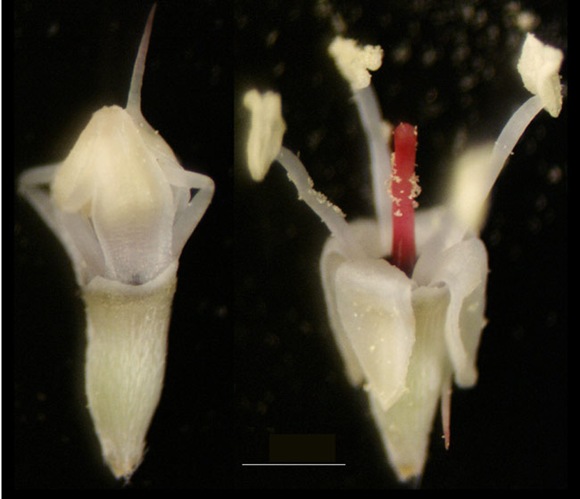
0505_closed_open_02 This shows a flower first closed and then open. The bar is 0.04 inches (1mm). Credit: M. Laskowski.

0505_pollen_catapult_02 Bunchberry
flower opening, recorded on video at 10,000 frames per second. Time
elapsed is indicated. First frame shows a closed flower with four petals
fused at the tip, restraining the stamens. Scale bar is 1mm. Credit: D.
Whitaker, M. Laskowski, A. Acosta, J. Edwards.


Venus Flytrap's Speed Secret Revealed

800px-Dionaea_muscipula_closed_cilia Closed cilia around the prey

The
Venus Flytrap, Dionaea muscipula, is a carnivorous plant that catches
and digests animal prey—mostly insects  and arachnids. Its trapping
structure is formed by the terminal portion of each of the plant's
leaves and is triggered by tiny hairs on their inner surfaces. When an
insect or spider crawling along the leaves contacts a hair, the trap
closes if a different hair is contacted within twenty seconds of the
first strike. The requirement of redundant triggering in this mechanism
serves as a safeguard against a waste of energy in trapping objects with
no nutritional value.

The carnivorous Venus flytrap plant can snap its clamshell leaves around an insect in less than a second. But how?

Unlike
animals, plants have no muscles or brains. And plants are not known for
their ability to move quickly, as a team of scientists and engineers
point out in the Jan. 27 issue of the journal Nature.

The
secret has been revealed: The flytrap's leaves snap from convex to
concave the same way that a contact lens can flip inside out, the
scientists say.

The team cut up leaves to study their natural
curls, and also painted fluorescent dots on intact leaves to track their
insect-devouring action with high-speed cameras.

Like most
lenses, Venus flytrap leaves are doubly curved, that is, curved in two
directions, which allows the leaves to store elastic energy.

With
a contact lens, the two directions are perpendicular to one another.
With a Venus flytrap leaf, they are not. That property creates an
especially rapid elasticity that causes the leaf to snap even more
quickly from convex to concave.

Source: www.livescience.com, wikipedia.org

548px-VFT_ne1 Venus Flytrap leaf


Bamboo - The Fastest Growing Woody Plants in the World

bamboo-forest

Bamboo is a group of perennial evergreens in the true grass family Poaceae, subfamily Bambusoideae, tribe Bambuseae. Giant bamboos are the largest members of the grass family.

In
bamboo, as with other grasses, the internodal regions of the plant stem
are hollow and the vascular bundles in the cross section are scattered
throughout the stem instead of in a cylindrical arrangement. The
dicotyledonous woody xylem is also absent. The absence of secondary
growth wood causes the stems of monocots, even of palms and large
bamboos, to be columnar rather than tapering.

Bamboos are also
the fastest growing woody plants in the world. They are capable of
growing up to 60 centimetres (24 in.) or more per day due to a unique
rhizome-dependent system. However, this astounding growth rate is highly
dependent on local soil and climatic conditions.

Bamboos are of
notable economic and cultural significance in East Asia and South East
Asia where the stems are used extensively in everyday life as building
materials and as a highly versatile raw product, and the shoots as a
food source.

Source: wikipedia.org

bamboo_thicket

bamboo-in-the-sun_resize
 
Support : Venus Net | Pagak City
Copyright © 2013. hot milf hardcord - All Rights Reserved
Template Created by Together Published by Venus Net
Proudly powered by Blogger